Friday, 8 November 2013

Problem Of Health With Your iPhone Alarm? Here’s A Tip

truth is thizz!!!
iPhone users around the world experienced a rude awakening on New Year’s Day. Or rather, they didn’t—because of a glitch in the iPhone’s calendar software, alarms set over the weekend failed to go off, causing tens of thousands of people around the world to be late, at least according to the tweets. It’s unclear just how widespread the problems have been or exactly why the glitch happened—Apple hasn’t offered an explanation, though a support page on its website told users to set their clocks to “recurring alarms,” rather than one-time alarms.

I’m  not an IT expert, so I can’t help you fix your phone. But here’s a tip for all of those angry Applets trying to figure out how to wake up on time if their iPhone alarm isn’t working: do not use your cell phone as an alarm! cell phone use and a higher risk of cancer, there’s enough worrying data out there to make it worthwhile to reduce your exposure to cell phone radiation whenever possible

But a number of scientists are worried that there has been a dangerous rush to declare cell phones safe, using studies they feel are inadequate and too often weighted toward the wireless industry’s interests. An analysis published by University of Washington neurologist Henry Lai determined that far more independent studies than industry-funded studies have found at least some type of biological effect from cell-phone exposure. Several countries — including Finland, Israel and France — have issued guidelines for cell-phone use. And San Francisco Mayor Gavin Newsom, who began researching the issue when his wife was expecting their first child, is hoping his city will adopt legislation that would have manufacturers print radiation information on cell-phone packaging and manuals and require retailers to display the data on the sales floor.

And if you read the fine print of the instruction manuals that come with cell phones, as TIME’s Michael Scherer pointed out last year, you’ll notice that wireless companies recommend that you should keep your handset about an inch away from your body—something government safety standards assume, even though few of us actually use our phones that way:

Consider the little-noticed bit of legalese that comes in the safety manual for Apple’s iPhone 4: “When using iPhone near your body for voice calls or for wireless data transmission over a cellular network, keep iPhone at least 15 mm (5/8 inch) away from the body, and only use carrying cases, belt clips, or holders that do not have metal parts and that maintain at least 15 mm (5/8 inch) separation between iPhone and the body,” the warning reads.
Similar warnings against carrying cellular and smart phones in a closely sewn pocket show up throughout the industry. The safety manual for Research in Motion’s BlackBerry 9000 phone tells users that they may violate Federal Communications Commission (FCC) guidelines for radio-frequency energy exposure by carrying the phone outside a holster and within 0.98 inches (2.5 cm) of their body. The safety manual of the Motorola W180 phone tells users to always keep the active device one full inch away from their body, if not using a company-approved “clip, holder, holster, case or body harness.

  • You can reduce your exposure to cell phone radiation—and any potential health hazard—simply by keeping the phone away from your body, texting more often and by using a headset when making and receiving calls. That’s what I do myself—it’s a slight inconvenience, but one that seems worth it. But most of all, you should not use your phone as an alarm, keeping an active device next to your bed—and your head—for hours as you sleep

CELL PHONES ENVIRONMENT & HUMAN HEALTH TECHNOLOGY EXPOSURES HEALTH EFFECTS

Introduction

What are the potential health issues associated with cellular telephone use?
Whether it’s the increased use of cell phones by children, or the overall increase in cell
phone use by adults, human exposure to electromagnetic radiation is happening in
ways never dreamed of before. Very young children are using them, teenagers live on
them—and some even sleep with them on their pillows, as cell phones are often used
as alarm clocks.
What do these exposures consist of and what do they mean for human health?
Whether cell phone use affects the human nervous system and reproduction, causes
DNA damage and behavioral changes, or creates addictive behavior, cell phones are
now ubiquitous in our lives.
Cell phone technology has changed quickly over time and continues to develop, which
means that human exposures also change over time. This report explores what we
know about cell phone use, exposures, and human health.

The Cell Phone Problem

Electromagnetic Radiation

■ All cell phones emit a type of radiation called an electromagnetic
field (EMF), composed of waves of electric and magnetic energy
moving together through space. Different types of ele
ctromagnetic
energy are categorized by their wavelengths and frequencies and
comprise the electromagnetic “spectrum” (see next page).
■ Different radiation frequencies are used by different technologies.
Radio waves and microwaves emitted by transmitting antennas are
a form of electromagnetic energy collectively referred to as radiofrequency
(RF) energy or radiation.
■ The RF part of the electromagnetic spectrum consists of frequencies
in the range of about 3 kilohertz (3 kHz) to 300 gigahertz (300
GHz). RF energy is used in telecommunications services, including
radio and television broadcasting, mobile communication, GPS
devices, radio communications for police and fire departments, and
satellite communications. Non-communication sources of RF
energy include microwave ovens, radar, and industrial uses.
■ The complete electromagnetic spectrum consists of both ionizing
and non-ionizing radiation. Non-ionizing radiation refers to any
type of electromagnetic radiation that does not carry enough
energy to remove an electron from an atom or a molecule. Sources
of non-ionizing radiation include microwaves, radio waves, cordless
phones, wireless networks (wifi), power lines and MRIs.

Thursday, 10 October 2013

Samsung's Galaxy Round is the 1st phone with a amazing curved display!!!!

galaxy round 
  buy@adsl-jazztelonline
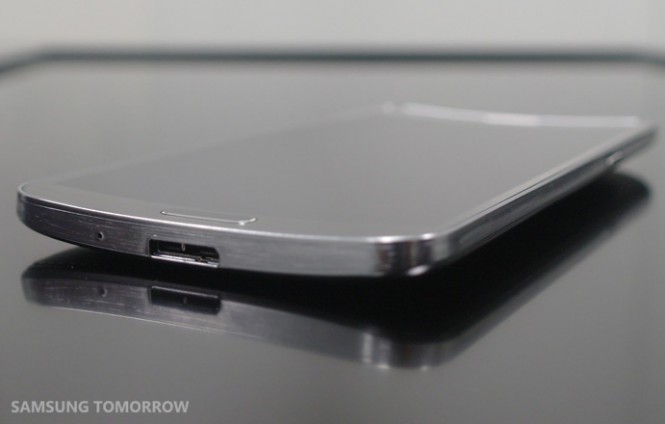
Samsung has taken the wrapper off its rumored smartphone with a curved OLED display. The Galaxy Round, which will launch on SK Telecom in South Korea, has a 5.7-inch 1080p screen the same size as seen on the company's Galaxy Note 3, but there's a difference — it curves on the vertical axis in a similar fashion to some of Samsung's OLED TVs.


Check battery life by tilting your phone on a table


The potential benefit of this screen technology isn't quite clear yet, but Samsung is touting a new feature called "Round Interaction," which allows you to look at information such as missed calls, battery life, and the date and time when you tilt it on a flat surface with the screen off. Samsung also claims that switching between home screens will feel like one continuous transition, and has worked on new tilt- and tap-based interactions for the music and photos apps.


Sam_8897-665x424 
Aside from the unconventional screen, the Galaxy Round has an impressive spec sheet. It's 7.9mm thick, weighs 154g, and has a 2800mAh battery. The camera is 13 megapixels, like the Galaxy S4 and Note 3, and the phone runs Android 4.3 atop 3GB of RAM and a 2.3GHz quad-core processor. It'll be released tomorrow in "Luxury Brown" for 1.09 million won (about $1,013) with more colors coming soon; no details of an international launch have been made available.


T-Mobile announcement unlimited global data roaming at no extra charge!!!!!!!!!!!


its totally amazing this time!!! 

Unlimited data and text plus discounted voice calling in over 100 countries are automatically included


T-Mobile unveiled the latest part of its Uncarrier initiative today: the carrier is offering unlimited international data and text services at no extra charge starting October 31st. The new international services will be available to existing Simple Choice customers for no additional cost over their current rate plans, and will work in over 100 countries across the world. In addition to the data and texting services, traveling customers will be able to place voice calls at a flat rate of 20 cents per minute while in those countries.
T-Mobile's new plans are significantly different than the industry is accustomed to — most international roaming plans are prohibitively expensive and have limited caps for data and text messaging.  
 CEO John Legere says that the included countries cover "pretty much everywhere people travel, about 95 percent of where people go."
Unlimited data and text plus discounted voice calling in over 100 countries are automatically included
        The carrier didn't provide a lot of details for the new plan — it didn't really describe the level of service that customers would get while they are in foreign countries. The company is providing options for customers to pay more for faster service while abroad: there will be options for daily, weekly, and two-week packages that provide the "fastest speeds we can deliver" over the standard, included unlimited service. While the company says the included data should be good enough for emails, social network status updates, and even streaming music, it's not particularly fast: just 128 kilobytes per second on average, chief marking officer Mike Sievert told CNET.
 Texting from the US to any of those countries is unlimited. Simple Choice customers are able to add the new plan to their existing service for $10 per month.

       In addition to the new, free roaming services, T-Mobile is also launching its new Stateside International Talk & Text feature, which offers discounted calling and text messaging from the United States to all of its participating Simple Choice countries. Calls to mobile phones will be 20 cents per minute, while calls to landlines are unlimited in over 70 of those countries. 

Tuesday, 1 October 2013

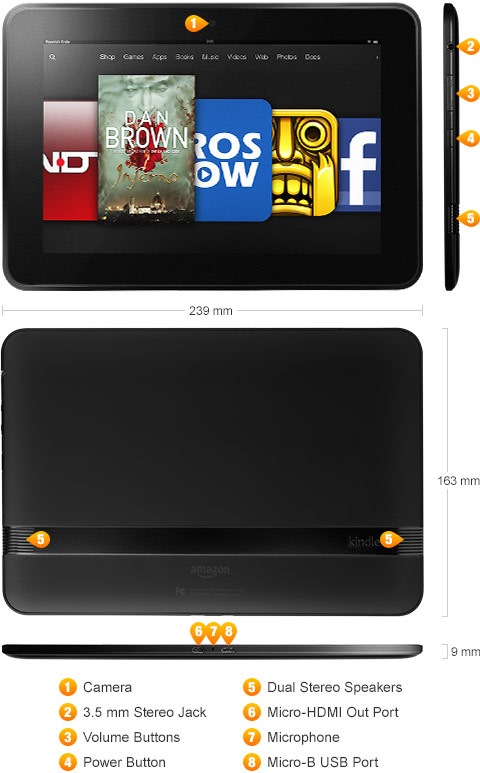
Amazon's new Kindle Fire HDX tablets: the full story

Amazon's new Kindle Fire HDX tablets: the full story

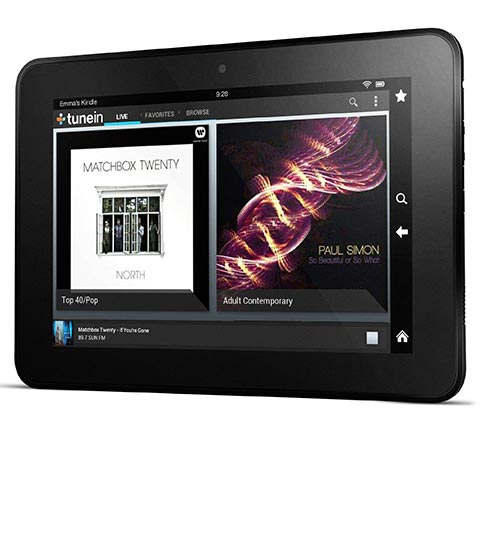
Kindle Fire HD 8.9" Tablet

Best buy @ iphone5

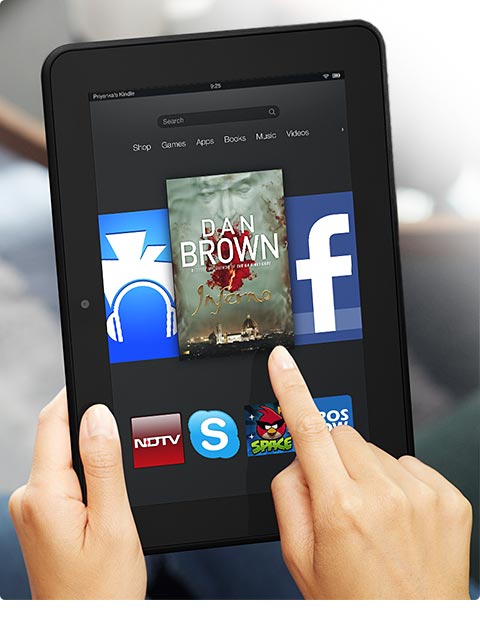
 Amazon is rolling out the brand-new Kindle FIre HDX with upgraded everything tonight, but last year's Kindle Fire HD isn't going anywhere anytime soon. In fact, the company announced that it is updating the tablet and cutting its price down to $139 — a very aggressive price point for a still-competitive tablet.

It also comes pre-loaded with the new Fire OS 3.0 software based on Android and includes improvements to X-Ray and other Kindle features. The Fire HD does not have the new Mayday live help feature coming with the Fire HDX, but it does give users the option to view their apps in a grid instead of just in the traditional Kindle carousel. Amazon claims that Fire OS 3.0 offers improved touch responsiveness compared to standard Android thanks to low-level improvements to touch latency.
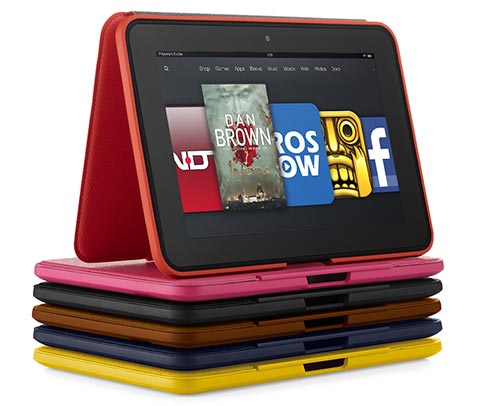
You can place a pre-order for the new Kindle Fire HD today, with units expected to ship starting on October 2nd. Additionally, Amazon is offering a set of optional folding Origami covers for the tablet, which let users stand it up on a table or protect it the screen from damage.
Compared to the Kindle Fire HD, the new models feature a jump in display density (216 PPI to 323 PPI for the 7" and 254 to 339 PPI for the 9"), a switch from a dual-core TI OMAP Cortex-A9 (at 1.2/1.5GHz) to a quad-core 2.2GHz Qualcomm Snapdragon, and a bump from 1G to 2G of RAM. On the software side, Android has been upgraded from 4.0 to 4.2.2 and Amazon added a few new features to their applications.

Amazon also announced the third generation of its Fire OS (the forked version of Android that runs the Fire tablets), dubbed “Mojito.”
Amazon made the announcement with little fanfare. The company did not have a fancy launch event where CEO Jeff Bezos or any of his top lieutenants stood on stage to pose for cameras with the device. Amazon just quietly sent a press release overnight packed with information about the new Fire tablets.
The 7-inch Kindle Fire HDX is likely the flagship of the series. Amazon has given both sizes of the HDX tablets a significant bump in hardware specifications. Both HDX tablets will runs a Snapdragon quad-core 2.2 GHz processor with 2 GB of RAM and twice the memory of last year’s Kindle Fire HD tablets. Amazon has packed a Adreno 330 graphics processor into the HDX tablets for better image rendering that will help the tablets running higher powered games.
The screens on the 7-inch and 8.9-inch Fire HDX tablets also got a spec upgrade. The 7-inch version ships with 1920x1200 pixel dimensions, good for 323 pixels per square inch (ppi). The 8.9-inch Fire HDX runs a screen at 2560x1600 (339 ppi).
The Kindle Fire HDX 8.9-inch will also come with an 8-megapixel rear facing camera.
Amazon also has several new software and content features for the Kindle Fire HDX tablets. Foremost among them is the ability to download Amazon Prime Instant Video movies and television straight to the tablets for offline viewing. Previously, Prime Instant Video was only available for streaming through Kindle Fire tablets. 
Amazon also released what it calls a “Mayday Button” for users that need instant tech support for their Fire tablets. The Amazon Kindle Fire expert will appear on your tablet within 15 seconds of pushing the Mayday Button to guide you through whatever tech problems you may be having with you device. 
The new Fire HDX tablets also have a new feature Amazon calls “Second Screen” which has the ability to stream content from your Kindle Fire to a television set. Second Screen will work with the PlayStation 3 and Samsung Smart TVs or any Miracast-enabled accessories. 
Amazon has also improved its “X-Ray” features that allow users to look up aspects of their content from within books, video and now music.
Amazon has also updated the enterprise-grade features on its Fire HDX tablets with new support for device encryption, Kerberos Intranet, secure Wi-Fi connections and VPN integration
 
All three of the new Kindle Fire tablets are available for preorder today and will ship on October 18th. The Kindle Fire HDX 7-inch will sell for $229 (with a 4G LTE version for $329). The 8.9-inch Fire HDX will sell for $379 ($479 with 4G LTE).