Saturday, 9 May 2015

Android ‘M’ could return privacy control to users

Focus on user data privacy is tipped for Google’s next version of Android, to bring it in line with Apple’s iOS and custom Android versions such as Cyanogen
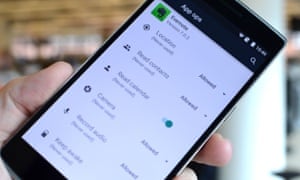

Android Cyanogen app opps


 Google is expected to implement user privacy controls for app data access, similar to iOS and custom Android versions such as Cyanogen. Photograph: Samuel Gibbs for the Guardian
Google is expected to bring Android into line with Apple iOS on user privacy, with version “M” due for release later this month, giving control of app data back to the users.
Android will include detailed control over personal data, such as phone numbers, location, names and addresses, and whether apps can access some or none or all of it, according to a Bloomberg report.
Apps installed on Android request permission to access various features and data of a mobile device, but a user can either accept all permission requests and install the app, or reject them and prevent the app from installing.
There is no middle ground and users cannot revoke permissions after the fact.

The return of AppOps

A hidden system of app permissions control called “AppOps” was implemented by Google with Android 4.3 Jelly Bean, accessible only by using a third-party application. The feature was said to be exposed in error and was removed in the next Android update to version 4.4 KitKat.
Third-party customised versions of Android – including Cyanogen, which shipped on the OnePlus One – allow users to control the types of data accessible to installed apps outside of the standard Android permissions.
Apple’s iOS has a similar system, where installed apps must ask permission to access data, such as location, the first time it is required. Users can approve the request once or forever, or deny it.
The issue with specifying permission to access certain data on Android is that apps often crash when they are denied access. Developers are likely to need to update their apps to handle the exceptions caused by data requests being blocked.
Several developer conference sessions at Google I/O in San Francisco later this month suggest that user permissions could be key to Android M, including a new system of website permissions.
Key to a new permission system will be protecting users from permission-request overload to avoid a scenario that is present in user agreements, where most users blindly say yes without reading what they are agreeing to.

Best buy on Walmart

Thursday, 5 February 2015

Parrot Zik 2.0 review: wireless headphones designed by Philippe Starck

Parrot has made the second generation of its Philippe Starck-designed wireless headphones lighter and given them better sound and battery life

NEWS of New Technology
Parrot’s new slimmer, lighter Bluetooth headphones are some of the most advanced available with effective noise cancelling, customisable sound and touch controls. 

Slimmer, lighter, more comfortable

Released in 2012, the original Philippe Starck-designed Zik headphones were feature-packed but heavy, uncomfortable to wear for any length of time and had mediocre battery life.
For version two, Parrot has shaved off 55g, slimmed down the ear cups and made the band more comfortable. The Zik 2.0s weigh 270g – still heavy for a generic set of headphones but similar to wireless competitors including the Beats Studio Wireless at 260g and lighter than the excellent Plantronics BackBeat Pro (340g).

Latest Information
Brushed metal arms and orange accents.

The new design is comfortable to wear, feels light on the head with a padded band and they stay put on the move. The ear cups completely encase the ears and double as effective earmuffs in cold snaps.
Compared to many garish headphones, the Zik are streamlined and elegant, covered in leather and with brushed aluminium arms and small orange accents. Beyond the single power button, they forgo buttons for an intuitive touch control scheme.
The right-hand ear cup is touch sensitive. A tap pauses and plays. Swipes up and down adjust volume and left and right skip tracks. It works very well - although not through gloves.

The headphones also have a sensor that pauses the music when you remove them from your head and plays again when put back on, which again, works very well.

Latest Information, Tech NEWS

They sit comfortably around the neck.  


App-controlled

Everything else is controlled by a free app on an iPhone or Android smartphone, including turning on, off or adjusting the level of noise cancelling, adjusting the equaliser and soundscape, and monitoring battery level. The app requires a user account, but periodically signs the user out, which can get annoying.
The soundscape can be adjusted to recreate the acoustics of a silent room, a living room, jazz club or concert hall, while the angle of attack of the sound can be adjusted from 180 to 30 degrees, making the music sound like it is coming from above.

Manual tuning of the equaliser using a circular visualiser is easy, but a collection of presets are also available, created by artists and DJs including Eurovision winner Conchita Wurst and DJ Jazzy Jeff from Fresh Prince of Bell Air fame, and for genres across electronic, hip hop, rock, pop and jazz.

Technoquist- Technical NEWS

The app controls everything but power and play controls.


A “producer mode” is also available that allows the user to tune the sound for each song and have the app remember the settings to switch back to when the song is next played.
Most of the features can be safely ignored and the equaliser left alone for decent sound, but it is there should the user fancy getting more involved with their music.
Overall, the sound quality from the Zik 2.0s when powered on is excellent, with a well rounded, energetic sound, solid definition in the highs and punchy bass. Of course all that can be adjusted to taste, making the Zik 2.0s some of the most flexible and configurable headphones available.

Wirefree

The headphones are wireless streaming over Bluetooth from any modern smartphone, tablet or computer, with solid signal and without interruptions. They also have NFC for one-touch pairing with an NFC smartphone or tablet.

A cable is provided in the box and they can be used with anything with a headphones port, either powered on or turned off, and will continue to work when the battery runs out.

Latest Technical NEWS
The removable battery should extend the headphones’ usable life as it can be replaced when it recharging capabilities start to decline.

The headphones last about six hours per charge with everything going and can cut out without warning, as there’s no battery indicator apart from inside the app.
Turning off noise cancelling adds another couple of hours, while they last around 10 hours with everything but Bluetooth turned off. A flight mode, which has noise cancelling but everything else including Bluetooth turned off, will give about 16 hours of use in my testing.

The battery is removable and spares are available, but they take 2.5 hours to charge and that can only be done in the headphones.

Noise cancelling

Technical NEWS
The headphones work well with calls, with clear audio at both ends of the call. 

The Zik 2.0s also include adjustable noise cancelling from a maximum of 30 decibel reduction through to “street mode”, which pipes the sounds of the outside world in through the headphones negating any passive noise isolation the ear cups might provide. The effect is surreal, especially in an office where the tap of keyboards is dramatically enhanced making it sound like it is raining indoors.
The headphones block out noise very well and the noise cancelling is some of the best I have experienced - similar to some of the best noise cancelling headphones on the market.

Price

The Parrot Zik 2.0 cost £299 and are available in black, blue, brown, orange, white and yellow.

Verdict

The Parrot Zik 2.0 are some of the best wireless headphones available. They are more configurable for personal audio taste using a simple app than any other headphones available in Britain.
They sound great, the noise cancelling is also top notch, and the touch controls are the best available on any wireless headphones. The battery life could be better, but a second battery helps.

Pros: solid bluetooth connectivity; excellent noise cancelling; great, customisable sound; useful app
Cons: app logs users out periodically; battery life could be longer; no on-headphone noise cancelling control or battery indicator.

Friday, 30 January 2015

Inbox by Gmail Invitations Opened for 24 Hours; Usage Statistics Shared

New Technology, Latest Technical information
New Technology

Google, to further promote its Inbox by Gmail app and roll it out to more people, has announced that it will be opening up invites to Inbox by Gmail for 24 hours. Notably, Inbox by Gmail has been an invitation-based app ever since its launch last year in October. The firm has also shared the worldwide app usage statistics in the form of info graphic.
The interested users who are yet to receive an invitation for the Inbox by Gmail service, can send an email to inbox@google.com from an @gmail.com address requesting access before Friday 9am PST (10:30pm IST) to get the invite.
As per the statistics shared by Google, Inbox by Gmail is used by 70 percent Android users, 28 percent iPhone users and 34 percent Web users across the globe. The company says 85 percent of the total email messages are bundled by users, most commonly into Promos (33 percent), Updates (20 percent), Forums (14 percent), Social (13 percent), and others (5 percent). Google said the top Highlights utilised by Inbox users were Purchase & Package Tracking (51 percent), followed by Calendar Invites (34 percent), Flight Info (9 percent), Reservations (4 percent), and Event Tickets (2 percent).
Google says that Inbox's Assist feature has been used the most to find phone numbers (47 percent), websites shortcuts (35 percent), and calendar events (12 percent). Speaking about the Reminders and Snooze features in Inbox, Google said 41 percent of Reminders are snoozed, and that 36 percent of users use Snooze six times a week. Top Snoozes choices are for custom time (28 percent), tomorrow (26 percent), later today (21 percent), next week (13 percent), someday (5 percent), location (5 percent), and last custom (4 percent).
The Gmail team last month updated its Inbox app to include Android Wear support. The update also brought improvements for Android tablets along with bug fixes and minor interface tweaks.


Thursday, 29 January 2015

Top 10 Latest Technology in Future

We are living in an era where dreams are turning into reality and we are witnessing new inventions about which we only read in novels before. We have compiled a list of 10 such technologies, which are in development and shall be available soon.
1. Artificial Gills
Technical NEWS
Artificial Gills
Think Aquaman (Although, we are not quite sure how he is useful). Just like flying; the capability of breathing underwater is one of those things that we have all wanted. Israel based inventor Alon Bodner has come up with a prototype; LikeAFish (that’s one smart name) which allows humans to breather underwater by generating oxygen from the water like the gills of a fish. The current issues are that of size and weight, however, progress is being made quite rapidly to overcome these issues.

2. Agricultural Robots
Best Technical Information
Agricultural Robots
Robotics is something that we only used to read about or see in movies. However, lately we are witnessing a world where robotics is progressing exponentially. Yet, agriculture is somewhat lacking in this department. Rumor has it that worldwide implementation for robotics to take over agriculture isn’t far. Currently there are a number of robots that are being researched upon and it includes a robot by a company based in Boston that is capable of performing 40% of the work usually done by manual labor. Then we have a robot in Japan capable of determining if the strawberries are ripe before it plucks them off. MIT hosts a cherry tomato garden, which is being maintained by robots. The plus point is that you can make them work 24/7 and they won’t complain.
3. Sunscreen Pills
Sun is good but too much of sun is bad and that’s why we have sunscreens. However, as is with humans we just can’t stop improvising stuff and now we want sunscreens that can be administered orally. So what we are looking for is a tablet, which we can take and then walk around in the sun while being protected. Good news folks; a study is being carried out at King’s College (London) and according to Dr. Paul Long who is the head of this three year project; ‘There would have to be a lot of toxicology tests done first but I imagine a sunscreen tablet might be developed in five years or so. Nothing like it exists at the moment.’
4. Paper-Thin, Flexible Computers and Phones


How would you feel if your smartphone or tablet was as thin as paper and capable of exhibiting the same level of flexibility? Would feel pretty awesome, no? The future has such gadgets for you in store. As of now projects are underway to come up with smartphones and tablets, which will be fully functional yet look just like paper. Papertab was showed in CES 2013 and a collaborative effort is being made by two Canadian and American universities and the project is being called; ‘Paperphone’. Dr. Roel Vertegaal from Queens University says; ‘This is the future. Everything is going to look and feel like this within five years.’


5. Tooth Regeneration


Tooth Regeneration
Going to the dentist is one of the most terrifying experiences. However, it is also one of the most crucial ones. Why is that so? Because if you damage your teeth then the damage is permanent and you’d have to live with that for the rest of your life. Yeah, that’s old new. The newsflash; scientists are working on to how to regenerate human teeth based on alligator’s system of regeneration, which comes into play when the tooth is damaged or lost. According to a study that was carried out in a lab at UTAH back in November 2012, humans can also regenerate teeth based on this alligator’s system in a lab with some modifications.

6. Holographic TV


This is more than just exciting; the future holds holographic television instead of your LEDs or extra HD TVs. The next generation of TV won’t be about the screen size and quality but rather about viewing area. MIT researchers have created a chip which is able to render a holographic display as good as real world – 50 Gigapixels per second. The cost of such TVs would be too high, that’s the general opinion, but Michael Bove, MIT’s Object based Media Group disagress; ‘The technology itself is one that’s easy and inexpensive and, as far as we are aware and Nature is aware, has never been applied to displays before.’ According to his speculations such TVs will be available in the next ten years or so.


7. Real-Time Google Earth

Real-Time,Google,Earth,Technical,NEWS

Google Earth is quite a wonder, wouldn’t you agree? Do you have any ideas on how to improve it? Well, for starters; let’s make it real-time. Welcome to Oxford where at RAL Space, scientists are busy in building video camera, 2, which are unlike any camera you have ever seen. The purpose for which they are being built is unique as well. Once in space, they will be pointed towards Earth and will be telecasting live. The cameras are basically 1 meter long tubes, which come clad with electronics and mirrors. They will be mounted on the exterior of International Space Station. The other approach that has been taken by Georgia Tech team makes use of live feeds to relay it onto Google Earth and hence, create a Real-Time effect.

8. Wireless Electricity


Among many fantasies that the mankind has, wireless electricity sure has earned its place. However, you would have to give this fantasy up because this is soon going to be a reality (about a decade or so). We have seen wireless charging for gadgets and that’s proof enough to build a structure onto. A number of companies are trying to come up with electric ‘hubs’, which will be capable of powering up an entire house. The work is based upon the research done by Marin Soljacic of MIT. The idea is to make use of the fact that some particular electromagnetic waves make it easy to transfer energy and electricity can be transferred between objects that are resonating at the same frequency.

9. Ultra–High Speed Tube Trains

We’ve already covered the Maglev trains here at wonderfulengineering, however, let’s take a look at them again. Japan has plans on shifting onto these trains by 2045. Since there are no wheels, hence no contact or friction and Maglev is capable of achieving a speed of 300 mph. The trains are levitated by maintaining an electromagnetic field.  However, the idea being put forward by a company based in Colorado is much faster, in fact according to their idea, the travelling shall be done at a speed of 4,000 mph. The company, ET3, has put forward a concept of Evacuated Tube Transport. The track is within a vacuum tube that has been sealed and pressurized. The G-forces which a passenger experiences are comparable to that of a highway ride though. ET3 already has built a prototype capsule and is looking forward to testing it out.

10. Sustainable Fusion Reactor

Best Technology, Sustainable Fusion Reactor
Fusion Reactor
Fusion reactors are already in play; your first reaction is predictable. However, wait till you grasp what’s really going on here. The nuclear power plants make use of nuclear fission and although we have some which employ nuclear fusion; they are too small. So seven members; US, EU, Russia, Japan, India, South Korea and China, are into a collaborative effort to build a large, sustainable nuclear fusion reactor and France has been chosen as the site. It would take some decades to get functional but the product is going to be 4 times more powerful than what comes from fission and way cleaner. The project is being called ITER, International Thermonuclear Experimental Reactor. The project ranks second among the list of cooperative International scientific feats.


Tuesday, 27 January 2015

Latest Top 10 Eco-Friendly Project


It's feasible to take easy eco-friendly steps in everyday technology. Take a glance at some grand technologies on the market nowadays that can help you decrease your carbon footprint and feel good about serving the Earth.

Although it isn't green in color, this laptop case's material is 100 percent eco-friendly. The exclusive felt-tech material is made completely from recycled bottles. Just because it's green, however, doesn't mean functionality is lacking. The case fits laptops 13.3 inches and under, and it's cushioned in 4 mm of padding. It's available from Kena Kai for $29.99.

Google made big waves when it bought thermostat company Nest for $3.2 billion in January. The "next generation thermostat" goes green at home with the Internet of Things by automatically adjusting home heat while away. The thermostat builds a personalized heating schedule as it adjusts to the perfect temperature, which the company said will let you save up to 20 percent on your monthly bill.

Bracketron claims that its Mushroom GreenZero wall charger is the most eco-friendly way to charge a phone. When other chargers are left plugged in, they still pull power even when they aren't charging a device. The Bracketron charger eliminates that unused power, lowering energy bills and cutting back on waste. A little bigger than a typical charger, the palm-sized device rings in at approximately $24.95.

It can be difficult to keep track of all the green products out there, but the Good Guide app makes it easy. Available for free on both iOS and Android, the app uses scientific ratings to give an eco-friendly score of 0 to 10 to more than 210,000 products and their manufacturers. Users can search by category -- or simply scan a barcode -- within the app to get a score before a purchase. The app works for all sorts of products, from pet food, to baby products, makeup, food and more.

Claiming to be the "most eco-friendly wireless mouse," the Genius DX-ECO 2.4 GHz BlueEye wireless mouse is both comfortable to use and good for the environment.The mouse is completely battery-free and its built-in gold capacitor allows for more than 100,000 recharges. The mouse takes only three minutes to charge before it is ready to go with its wireless technology. It retails for $34.49.

This SanDisk flash drive takes files on-the-go in eco-friendly style. The 16-GB USB flash drive is encased in bamboo rather than plastic or metal, making it more eco-friendly because bamboo grows quickly and releases more oxygen than other trees. The flash drive is available on Amazon for $16.79.

Data center company AISO.net claims to be an eco-friendly web hosting business. Since 1997, the company has worked to make its data centers and networks as green as possible. They are powered by on-site solar panels, water evaporation cooling systems that obtain water through rainfall and use atmospheric energy for air conditioning. The offices use mirrored tubes and windows to light the building, and they are covered with a "green roof" to cool the building.

Green Cloud Technologies recently launched a Plant-a-Tree initiative in partnership with Carbonfund.org, which quarterly plants a tree for every business customer. Carbonfund.org works to offset carbon footprints through reforestation. Green Cloud Technologies alone will plant more than 1,500 trees this year through the program.

D&H recommends the Acer V226WL 22" LED LCD Monitor as an eco-friendly desktop addition. The monitor is Energy Star-qualified, and  EPEAT gold-level compliant, which means it is recommended as a high-performance and environmentally preferred choice. The stand is magnetic, which is a nice addition to keep all those paperclips and other odds and ends organized. The monitor retails on Amazon for $140.52.

This Logitech keyboard works completely off  solar power, which means it needs neither batteries nor a plug to be up and running, even indoors. Without any cables, the keyboard's sleek and thin design keeps a desk decluttered. The Logitech Solar App can be downloaded right to a mobile device to keep track of battery power. The keyboard retails for $59.99.

Thursday, 22 January 2015

How to Treat By Self in Toothache?


Toothaches can vary greatly, from mild soreness to an unbearable throbbing pain in your teeth or around your jaws. Some of the main causes of toothaches are cavities, an infection, an exposed tooth root, a cracked tooth, gum disease, a loose filling, or jaw joint disorder. You can try the following ways to relieve your pain when you need to see a dentist.

1. clean cold place where swelling. Cold put a veil on the exterior of your cheeks if you develop symptoms swelling due to a toothache.
2. Ice to relieve pain. Putting cold compresses, ice or water in the mouth may help ease the pain. But if you think it makes you Srean teeth, you can avoid it.
3. The high deposit. The deposit is able to reduce the pressure at the site, and it can also help to relieve the pain.
4. Wash. You really cannot make a clean mouth to relieve pain, but you can use warm water to remove food debris stuck in their teeth, it can cause pain or make it worse. The crumbs in a small piece gum can cause intense pain like mine will destroy teeth. Take a full teaspoon salt, stir into warm water and get it mouthwash in the mouth and then spit it out.
5. The use of fiber cleaning teeth. This method is not a cure, but this is another way to remove the debris that may be trapped between teeth. Be careful about the food tastes too sweet, too cold or too hot. Each of these types of foods and beverages may also increase the pain and symptoms Srean state Srean teeth.
6. True veil or chewing gum. If your teeth soon stimulated air to cover it with a veil used to put on the teeth, which can be bought at the pharmacy, or chewing gum, which has less sugar until you can go to the dentists.

7. Pepper and Salt. Salt mixed with pepper can be of great use when a tooth becomes extremely sensitive as both the ingredients have antibacterial, anti-inflammatory and analgesic properties.

8. Garlic. Mix a crushed garlic clove (or garlic powder) with some table salt or black salt and apply it directly on the affected tooth to alleviate the pain. If you prefer, you can chew one or two cloves of garlic to get relief.Repeat this natural treatment for a few days.

9. Grind two whole cloves. Mix in a little olive oil or any vegetable oil and apply on the affected tooth. Another option is to dab a cotton ball in clove oil and rub it directly on the sore tooth. Or, you can mix a few drops of clove oil in half a glass of water and use it as a mouth rinse.


10. Salt Water. A simple glass of warm salt water can help treat a toothache. Mix half a spoon of common salt in a glass of hot water and use it to rinse your mouth thoroughly.

Thursday, 8 January 2015

Solar Powered cell Phones are a ray of hope for third world citizens


It is hard to believe that there are villages where people still live without electricity and other basic facilities like toilets and water. This is the harsh truth that inhabitants of several third world countries have to grapple with everyday. Technology has helped in turning the world into a village and every individual has the right of ripping the benefits offered by tech.
This is the age of smart phones, but unfortunately, people who live in villages of third world countries cannot use these devices. The main reason behind this is the unavailability of power grids, which leads to problem of charging cell phones. The solar cell phones are surely a boon for these people as they come with an ability to stay functional even when working off the grid.
Uganda Telecom has recently marketed a brand new range of cell phones that are powered by solar energy. The farmer and handymen of Ugandan villages have started using this device for communicating about their work and exchanging necessary information. Farmers can now find out the selling rates of crops in markets before they decide to grow a crop. Information can definitely help them in making correct choices. The increasing use of solar powered cell phones will make the farmer communities more aware about the market trends. Communication can also alert the rural communities about upcoming natural disasters, which will go on to save lives.
Availability of ample sunrays is important for running a device like the solar cell phone. Luckily, both South Africa and India get sun throughout the year. The scarcity of resources and unstable infrastructure has raised the price of electricity in the third world countries. Lower class people cannot afford electricity at all. Under such circumstances, the solar powered cell phones are expected to bring a new revolution.
Currently, around 3 billion people are using cell phones around the world. The makers of solar powered cell phones believe that the next billions of cell phone users will come from the third world countries and the developing markets. The future of these devices seems bright. No hackle charging is what the modern users are looking for that’s why people from all social strata are showing interest in using solar cell phones.